
What is The Code?
The Code (short for The Code of Conduct for the Protection of Children from Sexual Exploitation in Travel and Tourism) is a multi-stakeholder voluntary initiative with the mission to provide awareness, tools and support to the travel and tourism industry to prevent the sexual exploitation of children.
It is overseen by ECPAT International and implemented in cooperation with ECPAT’s global network of civil society organisations dedicated to ending the sexual exploitation of children. In some countries, The Code is represented by the Local Code Representatives (LCRs) – civil society organisations working on the ground in the communities.
Governance
The Code is managed as part of ECPAT International’s Programme on Private Sector Engagement and Child Protection. Its office is located at ECPAT International’s headquarters is in Bangkok, Thailand. The global initiative and coordination role is carried out by employees and consultants contracted by ECPAT International. ECPAT International is led by the Executive Director and overseen by a Supervisory Board. Network activities are supported and coordinated by ECPAT International. For more information, consult:
History
Historically, The Code was funded after the first World Congress Against Sexual Exploitation of Children organised by ECPAT International in 1996, at the time ECPAT Sweden developed The Code in partnership with the UNWTO and several Swedish tour operators. The Code was then run through global partnerships between the civil society organisations and travel and tourism industry.
Location
The Code was hosted in various locations. From 2001 to 2004 by the UNWTO (currently called UN Tourism) in Madrid, Spain. From 2004 to 2011 by ECPAT-USA (currently PACT) in New York, USA. From 2011, ECPAT International hosts and administers The Code’s secretariat in Bangkok, Thailand.
Awards
The Code received various awards, including Ashoka Changemakers’ Ending Global Slavery Award (2008), WTTC Tourism for Tomorrow Award, The Ethical Corporation Award, the BIRD Express Travel Award, PATA Gold Award, and Travel and Leisure Magazine’s Human Rights Leadership Award (2010). The SKAL Sustainable Development in Tourism Award (2013).
Funding
Over the years, The Code was co-funded by UNICEF (2004-2011), Swiss Secretariat for Economic Affairs, SECO (2012-2016), and co-funded through projects implemented over the years with BMZ/GIZ in partnership with Kuoni Group, TUI Travel, Accor Hotels, and ITB Messe (2013-2015). Membership fees for company members of The Code were introduced starting from 2011. Membership fees contribute to the work of the Local Code Representatives (LCRs) in local communities to protect children from sexual exploitation, and to the implementation of The Code, as a global programme of ECPAT International. The membership fee income is received and administered by ECPAT International. This specific income is explicitly presented in ECPAT’s annual financial statements and is integral part of ECPAT’s annual audits.
Evaluation
The most recent evaluation of The Code was conducted in 2024 to understand the types of outcomes that The Code had contributed to, how and why The Code is implemented differently across contexts of both domestic and international tourism, and how the Local Code Representatives (LCRs) navigate national and international partnerships and the shifting business and human rights trends. The Code activities are overseen by ECPAT International and subject to continuous MEL process.
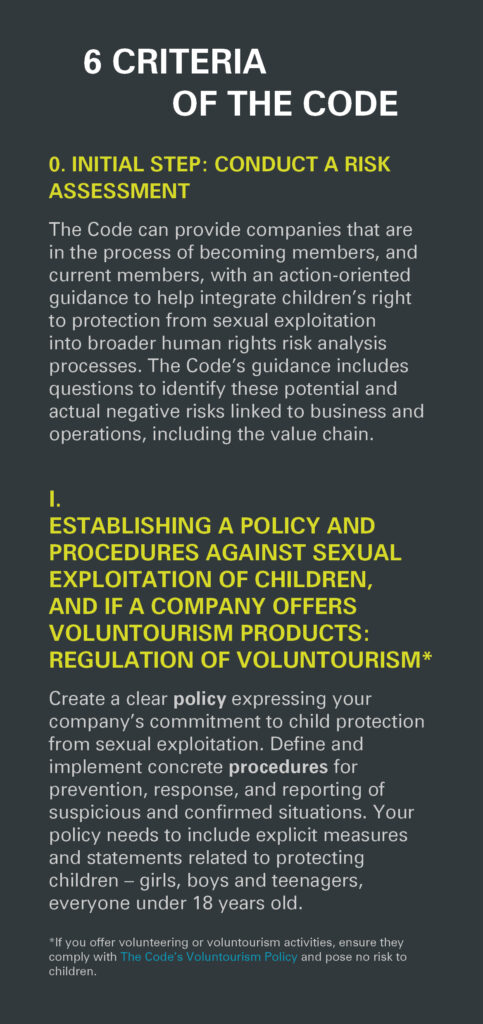
The Six Criteria of The Code.
-
Criterion 1
Establishing a policy and procedures against sexual exploitation of children, and if a company offers voluntourism products: regulation of voluntourism
-
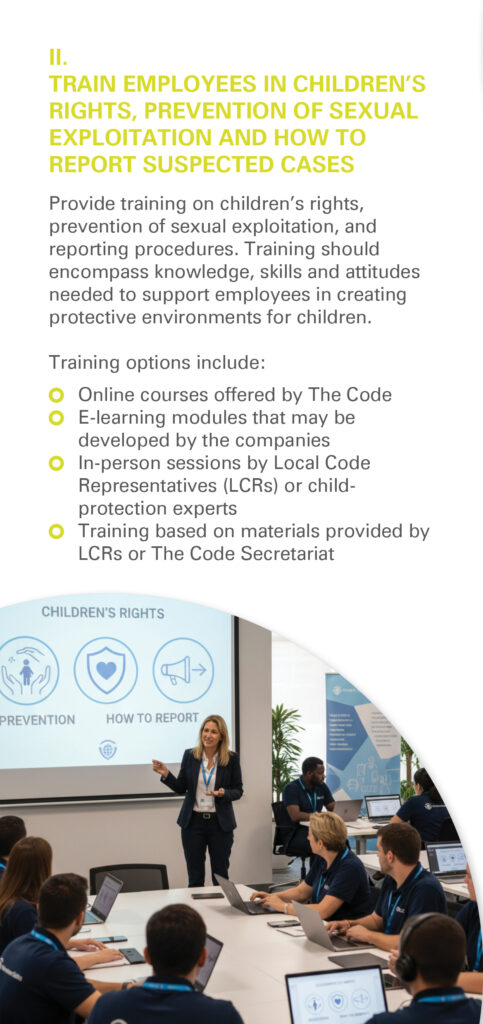
Criterion 2
Training employees in children’s rights, prevention of sexual exploitation and how to report suspected cases
-
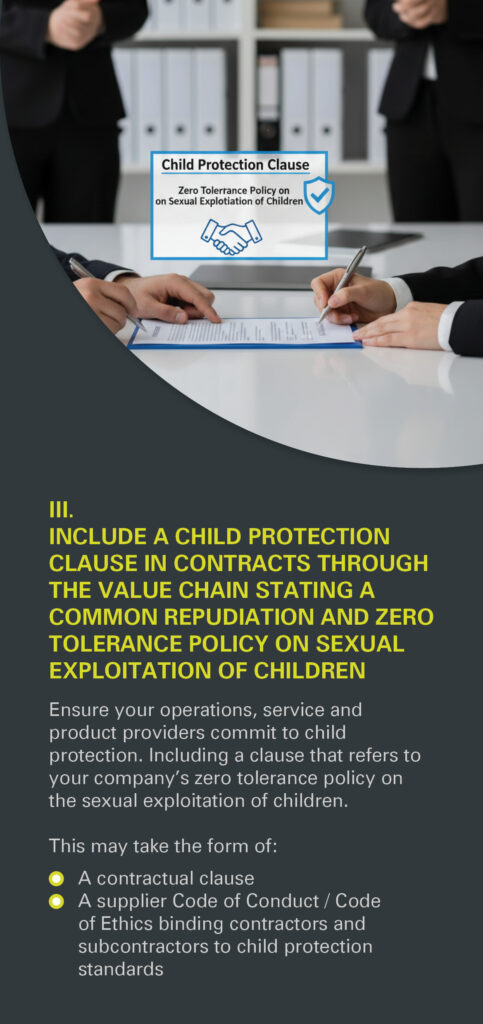
Criterion 3
Including a child protection clause in contracts or codes of conduct through the value chain stating a common repudiation and zero tolerance policy on sexual exploitation of children
-
Criterion 4
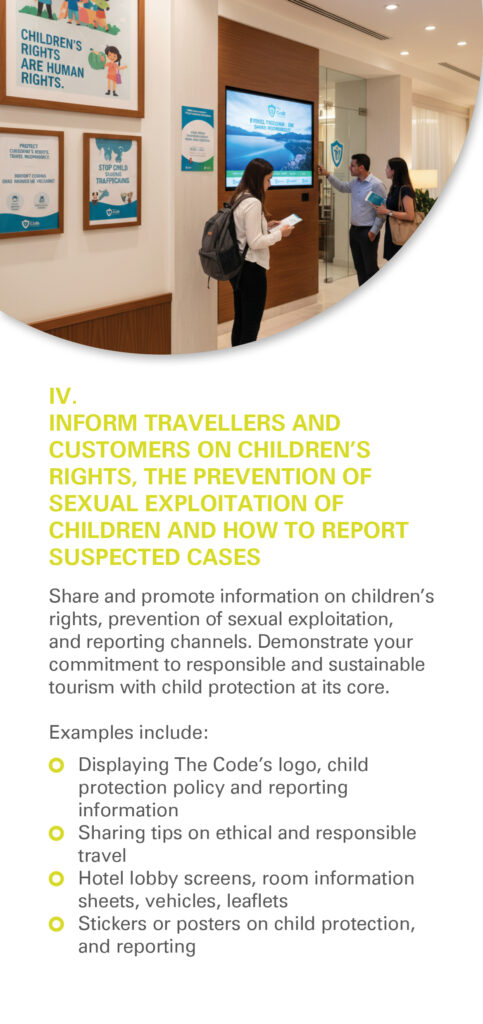
Informing customers, travellers and tourists on children’s rights, the prevention of sexual exploitation of children and how to report suspected cases
-
Criterion 5
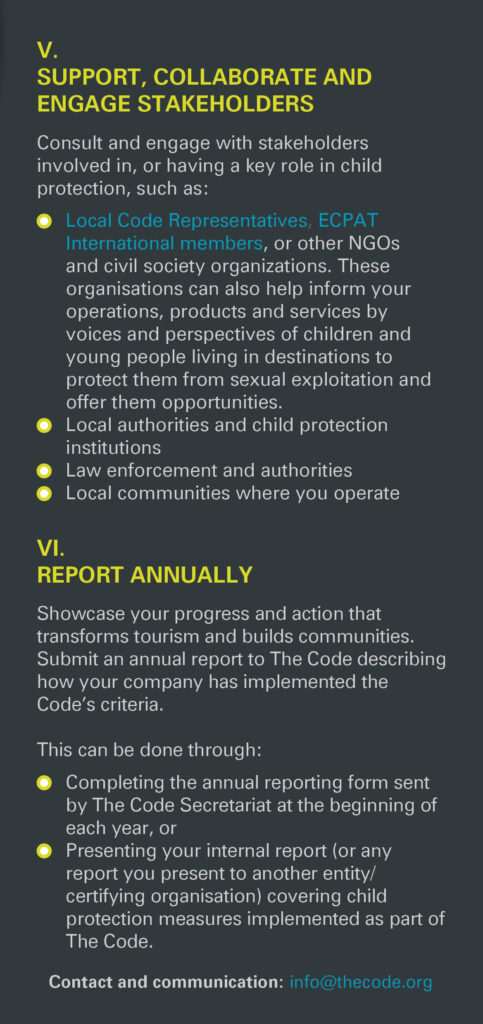
Supporting, cooperating and engaging with stakeholders in child protection area
-
Criterion 6
Annual reporting on the criteria implementation to The Code Secretariat
Local Code Representatives
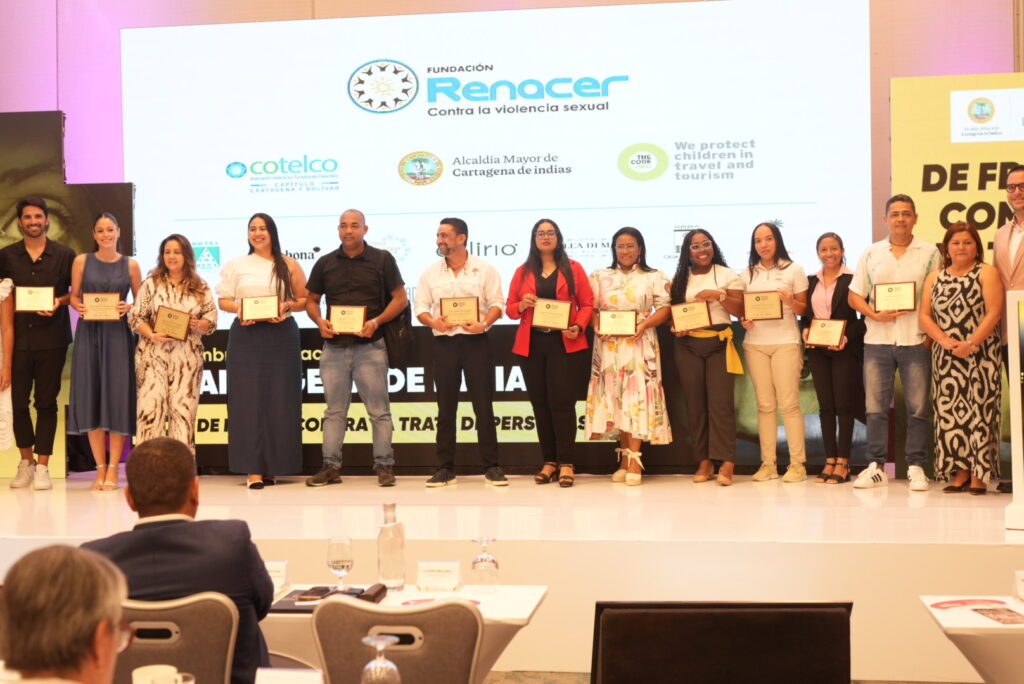
We are represented around the globe by local organisations who provide support to the travel and tourism industry to implement the six criteria of The Code. We call them Local Code Representatives (LCRs).
The Code is working with well-established NGOs and organisations that share our mission to protect children in travel and tourism. Currently, most of the Local Code Representatives (LCRs) are ECPAT members.
To establish cooperation or become a Local Code Representative please contact us here
More Questions?
There are six simple steps to becoming a member of The Code. The first step is to submit an application form. You can find out more about how to join The Code here.
You can contact us by filling out the contact form here. We will get back to you as quickly as we can.
No matter where we are in the world, we all have a responsibility to protect children. If you suspect child sexual abuse you should report it.
You can find out more about how to report in different countries here.
We are represented around the globe by local organisations who provide support to the travel and tourism industry to implement the six criteria of The Code. We call them Local Code Representatives.
We are always on the look out for new organisations to join us.
To become a Local Code Representative please contact us here.
The Code is a voluntary initiative supporting the travel and tourism industry. It is overseen by ECPAT International and implemented in cooperation with ECPAT’s global network of civil society organisations dedicated to ending the sexual exploitation of children. In some countries, The Code is represented by the Local Code Representatives (LCRs) – civil society organisations working on the ground in the communities.
The Code is managed as part of ECPAT International’s Programme on Private Sector Engagement and Child Protection. Its office is located at ECPAT International’s headquarters is in Bangkok, Thailand. The global initiative and coordination role is carried out by employees and consultants contracted by ECPAT International. ECPAT International is led by the Executive Director and overseen by a Supervisory Board. Network activities are supported and coordinated by ECPAT International. For more information, consult:
Historically, The Code was funded after the first World Congress Against Sexual Exploitation of Children organised by ECPAT International in 1996, at the time ECPAT Sweden developed The Code in partnership with the UNWTO and several Swedish tour operators. The Code was then run through global partnerships between the civil society organisations and travel and tourism industry.
Location: The Code was hosted in various locations. From 2001 to 2004 by the UNWTO (currently called UN Tourism) in Madrid, Spain. From 2004 to 2011 by ECPAT-USA (currently PACT) in New York, USA. From 2011, ECPAT International hosts and administers The Code’s secretariat in Bangkok, Thailand.
Awards: The Code received various awards, including Ashoka Changemakers’ Ending Global Slavery Award (2008), WTTC Tourism for Tomorrow Award, The Ethical Corporation Award, the BIRD Express Travel Award, PATA Gold Award, and Travel and Leisure Magazine’s Human Rights Leadership Award (2010). The SKAL Sustainable Development in Tourism Award (2013).
Funding: Over the years, The Code was co-funded by UNICEF (2004-2011), Swiss Secretariat for Economic Affairs, SECO (2012-2016), and co-funded through projects implemented over the years with BMZ/GIZ in partnership with Kuoni Group, TUI Travel, Accor Hotels, and ITB Messe (2013-2015). Membership fees for company members of The Code were introduced starting from 2011. Membership fees contribute to the work of the Local Code Representatives (LCRs) in local communities to protect children from sexual exploitation, and to the implementation of The Code, as a global programme of ECPAT International. The membership fee income is received and administered by ECPAT International. This specific income is explicitly presented in ECPAT’s annual financial statements and is integral part of ECPAT’s annual audits.
Evaluation: The most recent evaluation of The Code was conducted in 2024 to understand the types of outcomes that The Code had contributed to, how and why The Code is implemented differently across contexts of both domestic and international tourism, and how the Local Code Representatives (LCRs) navigate national and international partnerships and the shifting business and human rights trends. The Code activities are overseen by ECPAT International and subject to continuous MEL process.